Physician Staffing Is a Workforce Strategy, Not Just a Recruiting Problem
November 24, 2026
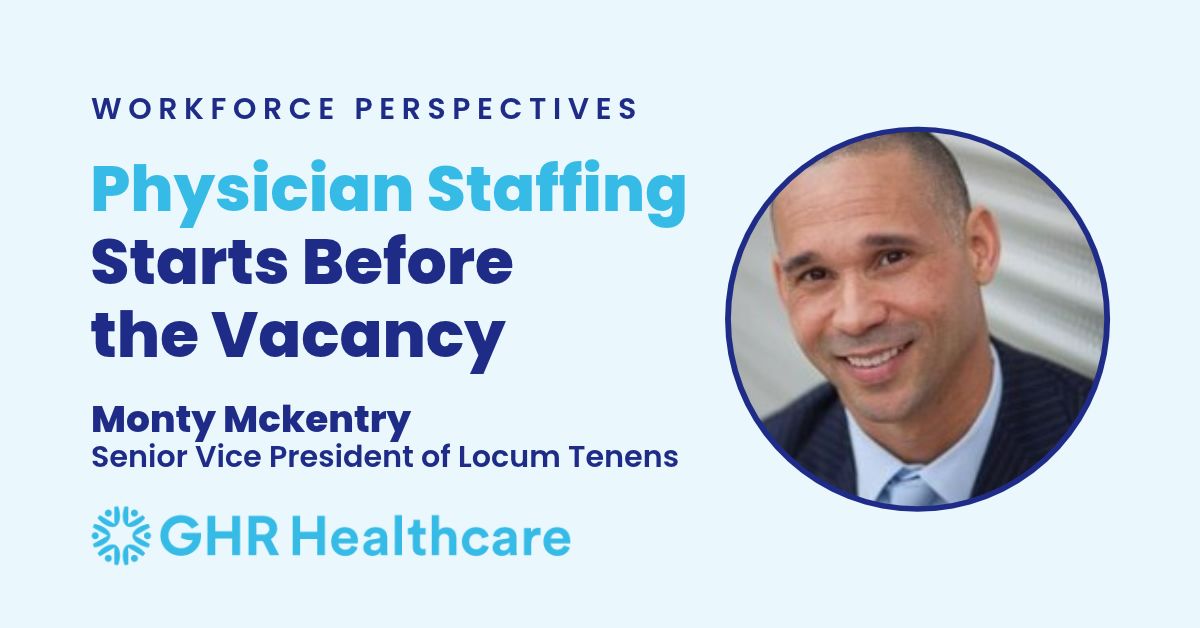
By Monty Mckentry, Senior Vice President of Locum Tenens
Physician vacancies rarely become costly on the day a provider leaves.
The impact often begins much earlier, as patient demand starts to outpace capacity, workloads become harder to sustain, a retirement approaches without a succession plan, or a difficult-to-recruit specialty becomes increasingly dependent on one or two physicians.
Yet too often, the staffing conversation does not begin until there is an open position to fill.
By that point, appointment availability may already be narrowing. Existing physicians may be absorbing additional patients or call responsibilities. Growth plans may be slowing. And recruitment teams may be working against a compressed timeline that limits the organization’s options.
Over more than two decades in healthcare staffing, I have worked across physician and locum tenens staffing, allied health, nursing, recruitment, and operations. One pattern has remained consistent: healthcare organizations are better positioned to navigate physician shortages when staffing is treated as an ongoing workforce strategy rather than a response to an urgent vacancy.
Physician staffing affects far more than recruitment. It influences patient access, clinician sustainability, service-line performance, and an organization’s ability to grow.
That makes it a workforce planning issue long before it becomes a recruiting one.
The Risk Begins Before the Vacancy
The physician workforce is already under significant pressure. According to the Association of American Medical Colleges, the United States could face a shortage of up to 86,000 physicians by 2036, affecting both primary and specialty care.
But national projections only tell part of the story.
For healthcare organizations, workforce risk is fundamentally local. A specialty that appears adequately staffed nationally may still be extraordinarily difficult to recruit in a particular community.
Geography, compensation, call expectations, credentialing requirements, patient volume, competition, and the available provider pool all influence how quickly an organization can replace a physician.
That means the number of open requisitions alone does not tell the full story of an organization's workforce risk.
The better questions are the ones organizations can ask before the opening occurs:
- Which physicians may be approaching retirement?
- Where are patient volumes beginning to exceed available capacity?
- Which specialties consistently require longer recruiting timelines?
- Where are workloads or call requirements becoming difficult to sustain?
- Which service lines depend heavily on one or two physicians?
- What would happen if a critical provider left unexpectedly?
- How long could the organization maintain patient access while searching for a replacement?
Those questions shift the conversation from filling vacancies to identifying workforce exposure.
Plan for Coverage Before You Need It
Permanent recruitment remains essential, but it works best when it is part of a broader coverage strategy.
When an organization can anticipate a retirement, expansion, leave, or potential capacity gap, it has time to evaluate how care will continue while a long-term solution is developed.
Depending on the situation, that may mean adjusting schedules, redistributing appropriate responsibilities, integrating advanced practice providers, bringing in locum tenens physicians, or combining several approaches.
The advantage is not simply filling a role sooner. It is preserving options.
When planning begins early, leaders can evaluate what the organization actually needs, determine which workforce model makes sense, protect existing clinicians from unnecessary strain, and avoid making a consequential staffing decision under pressure.
This is where locum tenens can play a particularly strategic role.
Rather than viewing temporary physician coverage only as an emergency response, organizations can use it deliberately to:
- Maintain patient access during permanent recruitment
- Prepare for anticipated retirements or planned leave
- Support existing physicians during periods of increased demand
- Preserve coverage during service-line expansion
- Evaluate demand before committing to permanent headcount
- Maintain flexibility during periods of growth or organizational change
The goal is not to make temporary coverage the default.
It is to keep a foreseeable staffing gap from becoming an operational crisis.
Build an Early-Warning System for Workforce Risk
Proactive workforce planning does not require leaders to predict every resignation or unexpected leave. It requires a repeatable way to identify risk early enough to preserve options. I think about that risk across three interconnected areas:
Provider Risk
Market Risk
Identify specialties with historically long recruitment cycles, limited regional supply, significant competition, or geographic challenges that make attracting physicians more difficult.
Operational Risk
Determine which vacancies would have the greatest impact on patient access, procedure volume, referral patterns, physician workload, service-line performance, or financial performance.
Looking at these factors together creates a much clearer picture than reviewing open requisitions alone.
Not every vacancy carries the same level of risk.
A physician role that routinely takes nine months to fill and supports a growing service line requires a different strategy than a position with stable demand and a strong regional candidate pool.
The more consequential the role, the earlier the planning should begin.
Ask a Different Workforce Question
That change in perspective matters.
It gives organizations more time to recruit deliberately, evaluate permanent and interim coverage options, protect existing clinicians, and make workforce decisions based on long-term needs rather than immediate pressure.
No workforce strategy can eliminate every unexpected vacancy.
But it can reduce the likelihood that one physician's departure immediately affects patient access, puts additional strain on the remaining team, or disrupts a critical service line.
The strongest physician staffing strategies begin before the requisition opens. They connect recruitment, coverage, provider capacity, patient demand, and organizational growth within one coordinated plan.
Because the best time to solve a physician staffing problem is before it becomes one.
Key Takeaways
- Physician staffing is a workforce strategy, not simply a recruiting function.
- Workforce risk should be evaluated across provider, market, and operational factors, rather than by open positions alone.
- Succession and coverage planning should begin before an anticipated vacancy becomes urgent.
- Locum tenens physicians can provide strategic flexibility while organizations recruit, grow, or navigate periods of change.
- Organizations that identify workforce exposure earlier retain more options and greater control over their staffing decisions.
About Monty Mckentry

Monty Mckentry – Senior Vice President of Locum Tenens
Monty Mckentry brings more than 20 years of healthcare staffing leadership experience across locum tenens, physician staffing, allied health, nursing, recruitment, and operations. Throughout his career, Monty has helped healthcare organizations navigate provider shortages, expand workforce capacity, maintain patient access, and develop more sustainable approaches to physician staffing.
Articles & Free Resources
Subscribe to GHR's Blog Newsletter
Your submission was successful.
Thank you for subscribing — we'll be in touch!